The March-April Window: What Makes Spring the Tipping Point
European commuting data consistently shows a spike in cycling rates beginning in late March, with the steepest growth occurring through April. Several interconnected factors explain this seasonal clustering.
Daylight Returns in Usable Hours
After the brief daylight windows of December through February, March brings a rapid expansion of usable riding hours. By late March, most of northern and central Europe has enough light before 8am and after 5pm to commute without relying entirely on bike lights. This psychological shift from navigating near-darkness to riding in full daylight is significant for riders who were deterred by winter conditions rather than temperature alone.
Temperature Crosses the Comfort Threshold
Average morning temperatures in Germany, France, the Netherlands, and the UK typically cross the 8-10 degrees Celsius range in late March. This is broadly accepted as the comfort threshold below which casual and occasional cyclists tend not to ride. Committed commuters ride through lower temperatures, but for the larger group considering making e-biking a regular habit, that threshold matters. April consolidates the shift as temperatures stabilise further.
Motivation From Environmental and Cost Pressures
Fuel costs and urban congestion charges have continued to make car commuting more expensive across European capitals. The European Cyclists Federation data on modal shift shows that cost savings and environmental motivation are among the most cited reasons for switching to bicycle commuting, with e-bikes particularly appealing to people for whom distance or fitness level previously ruled out cycling as a practical option.
March and April are the months when that calculation becomes concrete. People returning from winter holidays or completing a fresh budget review begin calculating what their commute actually costs versus what it could cost on an e-bike.
Why E-Bikes Specifically, and Not Regular Bikes
The growth in spring cycling is not evenly distributed between conventional bikes and e-bikes. E-bikes are attracting a category of commuter that traditional cycling never fully reached: people for whom distance, sweat on arrival, hilly routes, or physical fitness constraints made a conventional bike impractical.
Pedal Assist Changes the Equation for Distance
Most European commuters live between 5 and 25 kilometres from their workplace. That range presents no difficulty for e-bike riders using a 5-level pedal assist system, but it is the outer edge of what many regular cyclists find manageable on a daily basis without arriving at work visibly tired. Research on e-bike commuting adoption from the European Transport Safety Council supports the finding that the elimination of arrival sweat is one of the strongest practical motivators for choosing an e-bike over a conventional bicycle for commuting.
Hills and Headwinds Stop Being Problems
Cities like Lyon, Edinburgh, Lisbon, and Zurich have topography that discourages cycling among those who do not ride regularly. E-bike motor assist levels out gradient differences so that a rider choosing between a flat route and a hilly shortcut can take the shortcut. This route flexibility is particularly valuable in spring when riders are building the habit and want commuting to feel achievable rather than punishing.
Range Is Not the Limiting Factor It Used to Be
Early concerns about e-bike range and charging frequency have been addressed by improvements in battery capacity. A modern e-bike with a 48V 20Ah battery and a five-level pedal assist system gives a commuter sufficient range for most European daily commuting patterns without needing to charge every day, depending on terrain and assist usage. This removes a practical objection that previously discouraged potential switchers.
The Infrastructure Context: Europe's Cycling Network Supports the Switch
Spring commuters are also benefiting from years of sustained investment in European cycling infrastructure. The EuroVelo network expansion and national cycling strategy updates have progressively improved the quality and continuity of protected cycling routes in cities like Amsterdam, Copenhagen, Berlin, and increasingly in cities that historically lagged behind such as Paris, Brussels, and London.
Protected lanes reduce the anxiety barrier for new commuters who have hesitated at the prospect of riding in traffic. Spring is the season when people first test those routes, and many find the experience more manageable than anticipated. The decision to continue into summer and beyond often hinges on that first spring experience.
For commuters arriving from suburbs or connecting through urban fringes where infrastructure is less complete, the motor assist and stability of a well-built e-bike compensate for the stretches where dedicated lanes give way to mixed-traffic roads.
Choosing the Right Kimdyma E-Bike for Your Spring Commute
Selecting an e-bike for commuting involves matching the bike to the actual conditions of the route: surface type, distance, terrain, rider height and preference, and whether the bike will also be used for weekend riding. All three current Kimdyma models carry IP65 water resistance, Samsung 48V 20Ah lithium batteries with BMS protection, Shimano hydraulic disc brakes, and five-level pedal assist systems. The differences lie in geometry, tire format, and motor configuration.
Kimdyma TITAN X: For the Mixed-Terrain Spring Commuter
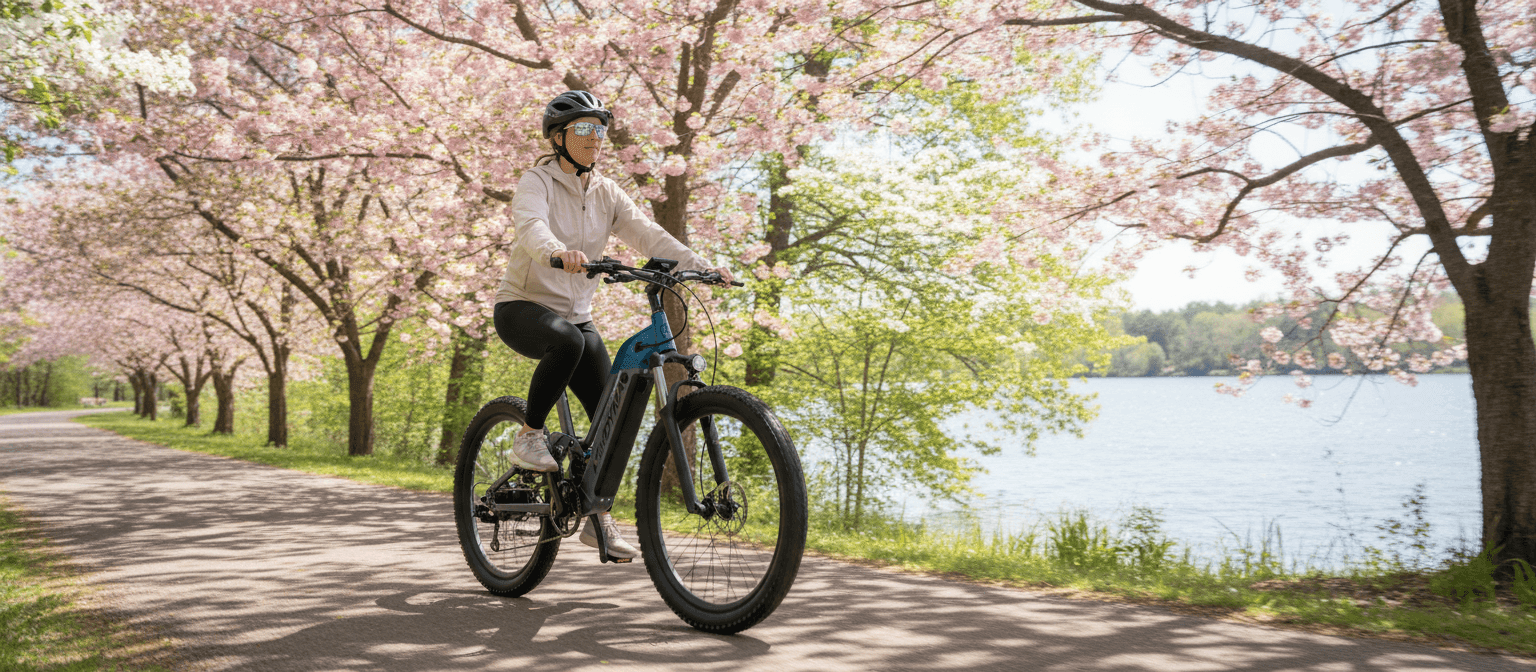
The TITAN X high-performance electric mountain bike is built around a full-suspension aluminum alloy frame with a TNL air-pressure adjustable front fork and a DNM 190mm rear shock. Its 27.5 x 2.8 inch all-terrain tires and 500W rear hub motor producing 80 Nm of torque make it well-suited to commutes that involve unpaved sections, rougher urban roads, or routes that connect directly to trail access.
The 48V 20Ah Samsung battery supports up to 130 km in pedal-assist ECO mode, meaning a 20-25 km daily commute can comfortably run several days between charges. Shimano M200 hydraulic disc brakes with 160mm rotors provide reliable stopping in the variable wet and dry conditions typical of a European spring morning. The 21-speed drivetrain with Shimano SL-M3000 shifters gives precise control across urban gradients and suburban climbs.
Riders between 165 and 195 cm will find the geometry well-proportioned for an upright commuting position. The TITAN X suits those whose route crosses a mix of tarmac, gravel, and lighter off-road surfaces without requiring a dedicated mountain bike for the weekend.
Kimdyma Aurora S: For the Urban and Suburban Daily Rider
The Aurora S electric mountain bike with step-through design shares the core specifications of the TITAN X, including the 500W motor, 48V 20Ah Samsung battery, IP65 rating, DNM rear shock, and Shimano M200 hydraulic disc brakes, while offering a step-through frame geometry that distinguishes it meaningfully for commuting use.
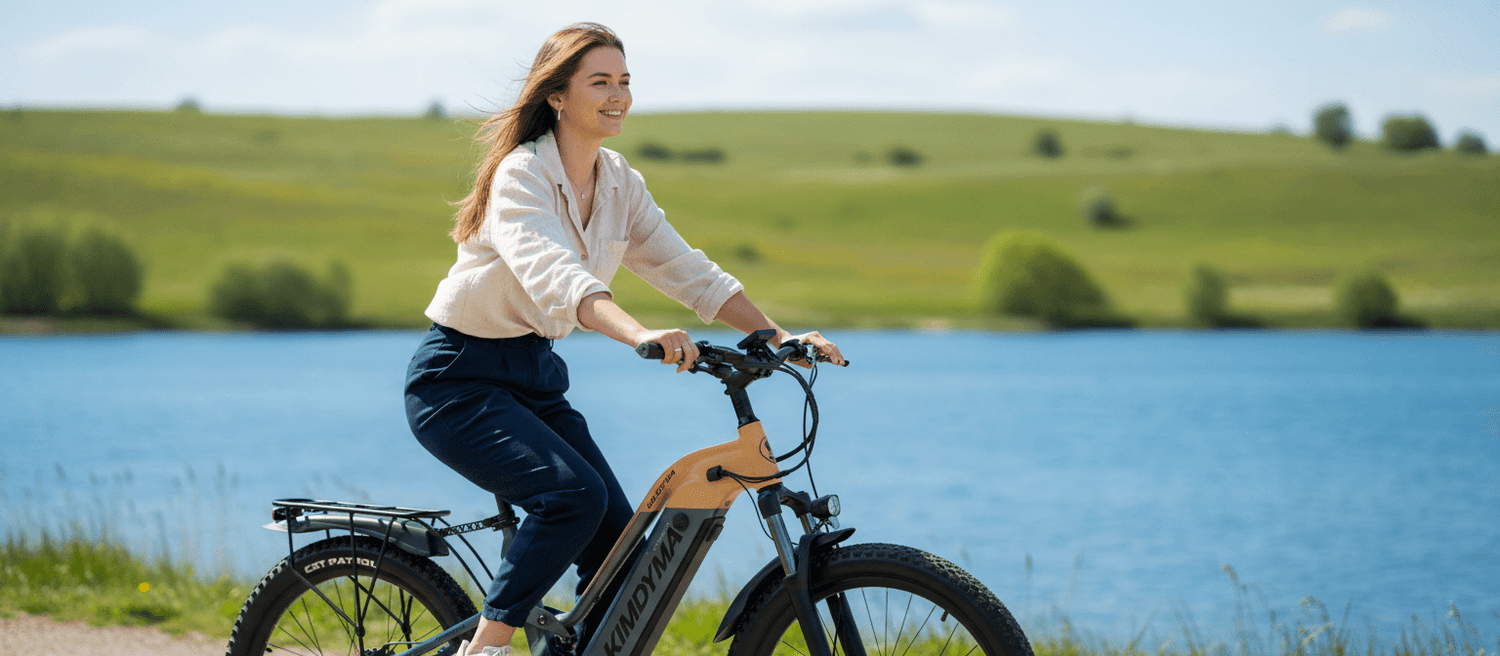
The low-entry step-through frame makes mounting and dismounting faster and more natural in commuting environments: at traffic lights, pedestrian crossings, and busy intersections where stopping and starting is frequent. It also suits riders who prefer to commute in regular clothing without adapting their movement to a high top-tube. The 27.5 x 2.8 inch tires handle both smooth urban roads and park paths with composure.
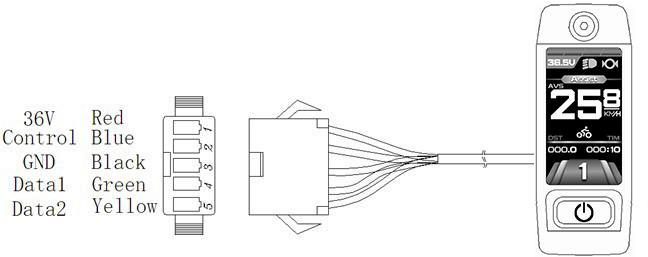
At 130 km of pedal-assisted range and a five-level PAS system matched to a KT-LCD5 display showing real-time battery status and trip data, the Aurora S is a practical daily commuter that does not ask for compromises in either performance or comfort. It fits riders between 165 and 195 cm with the added accessibility of the step-through design.
Kimdyma K03 Ranger: For the Adventurous Multi-Surface Commuter
The K03 Ranger dual-motor fat tire electric bike represents a different philosophy. Its dual 750W brushless hub motors, one at the front wheel and one at the rear, deliver a combined 1500W system output with power distributed across both axles. This all-wheel-drive configuration provides traction stability that single-motor bikes cannot replicate, particularly on loose, wet, or mixed-surface routes.
The 26 x 4.0 inch fat tires significantly increase the contact patch with the riding surface, which translates to confident handling on cobblestones, gravel shoulders, and lightly surfaced cycle paths that form part of many suburban European commute routes. The Shimano MT200 hydraulic disc brakes handle stopping reliably across those variable surfaces.
Range is more conservative at 60-80 km per charge, reflecting the energy demands of the dual-motor system. This remains sufficient for most European urban and suburban commutes, but riders with longer distances should plan charging accordingly. The total load capacity of 200 kg and the frame-integrated LCD display make it a practical choice for riders who also need to carry cargo or who commute on routes that genuinely challenge lighter e-bikes. Recommended rider height is 165-195 cm.
What New E-Bike Commuters Should Know Before Starting
Plan Your Charging Routine Before Your First Week
The most common friction point for new e-bike commuters is an unplanned charging situation. Before beginning a regular commute, establish whether charging will happen at home each evening, at the office, or a combination. All three Kimdyma batteries are removable, which means the pack can be taken off the bike and charged indoors without needing to bring the whole bike inside. A 6-8 hour charge from empty to full covers an overnight charge conveniently.
Understand Local E-Bike Regulations
EPAC regulations vary slightly between EU member states and the UK post-Brexit, but the general framework under EN 15194 pedelec standards limits pedal-assist output to 250W continuous and assistance to a maximum of 25 km/h on public roads across the EU. All three Kimdyma models are EPAC-compliant for public road use in pedal-assist mode. Riders should verify any local rules regarding lighting requirements, helmet regulations, and cycle lane access in their specific city or region.
Security Matters More for Regular Commuters
A bike left at a work rack or transit hub for eight hours faces a different security risk than one parked briefly for errands. Invest in a high-quality D-lock or folding lock rated to a recognised standard. Registering the bike's serial number with a national or regional cycling register adds a recovery layer if the bike is stolen. All Kimdyma batteries are removable and lockable, which removes the battery from the risk entirely when the bike is left outside.
Build the Habit Gradually
Starting with two or three commute days per week rather than switching entirely from day one reduces the pressure of the adjustment period. Spring weather still varies, and having the flexibility to take other transport on genuinely difficult days while building cycling days gradually leads to a more durable habit. Most new e-bike commuters find that within four to six weeks the bike has become the default rather than the alternative.
The Financial Case for Switching in Spring
Calculating the commuting cost comparison between a car, public transport, and an e-bike over twelve months consistently favours the e-bike for distances under 30 km when factoring in fuel or ticket costs, parking fees, and time. The upfront cost of the e-bike is offset across the first one to two years of regular use for most European commuters.
Spring is the practical moment to begin that calculation because a bike purchased in March or April goes into immediate regular use during the best months of the year for cycling, generating tangible savings from the outset rather than sitting in storage for several months. The emotional return on investment, arriving at work refreshed rather than stressed, is harder to quantify but widely cited by new converts.
E-Bike Technology That Makes Spring Commuting Smarter
The pedal-assist systems used in modern commuting e-bikes have improved considerably from the early generation of add-on motor kits. Contemporary torque sensor and cadence sensor integration in e-bike PAS systems now produces a responsive, natural-feeling power delivery that adjusts to the rider's input rather than switching between fixed output levels. All three Kimdyma models use a five-level PAS system with torque simulation control, meaning assistance scales smoothly with pedalling effort across all five modes.
The KT-LCD5 display fitted to the TITAN X and Aurora S, and the colour LCD display on the K03 Ranger, provide real-time readouts of battery level, current speed, trip distance, and PAS level. Having clear battery data visible during a commute removes range anxiety from the equation and lets riders make informed decisions about assist level based on remaining charge and distance to destination.
Battery management systems built into the Samsung cell packs provide cell-level monitoring, protecting against overcharge, over-discharge, and thermal events. Understanding how BMS technology protects lithium e-bike batteries gives riders a clearer picture of why these systems are worth prioritising when selecting a commuter e-bike.
March and April Are the Best Time to Start Riding
The data, the infrastructure, the weather, and the economics all converge in spring to make March and April the most natural window for making the switch to e-bike commuting. Starting during these months means building the habit in good conditions, establishing a charging routine before winter demands more planning, and getting the maximum seasonal value from the investment.
For riders whose commute crosses technical terrain, the TITAN X full-suspension e-mountain bike handles mixed surfaces without compromise. For those commuting primarily on urban and suburban roads who want a practical, accessible frame, the Aurora S step-through e-bike offers the same core performance with easier mounting and a more commuter-friendly geometry. For riders whose routes demand maximum traction and stability across variable surfaces, the K03 Ranger dual-motor fat tire e-bike delivers all-wheel-drive confidence and fat-tire grip that single-motor bikes do not match.
Spring waits for no one. If the timing has felt right for a while, March and April are the window to act on it.