


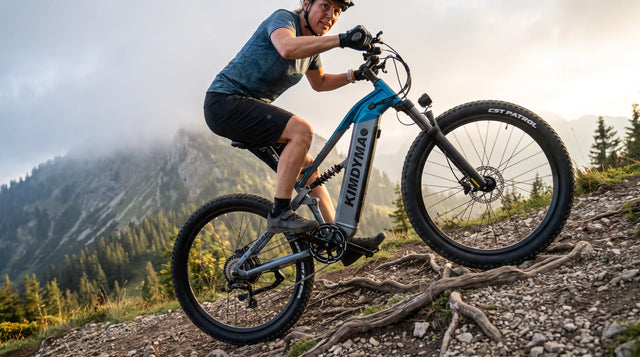
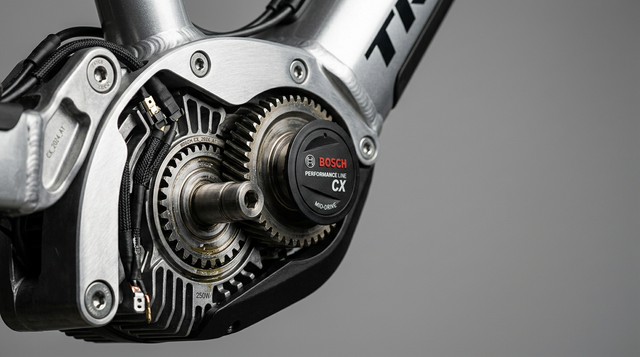
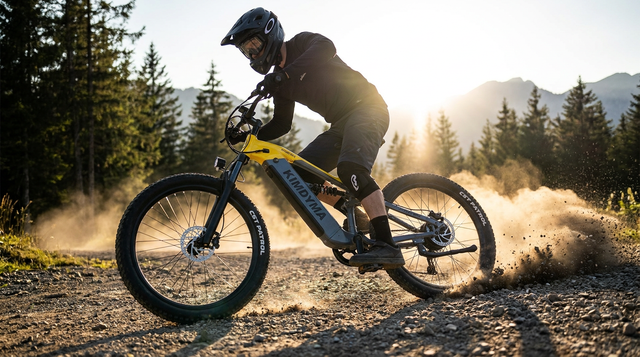
Mid-drive motors (50–90 Nm) are more efficient on varied terrain and feel natural on hills; hub motors are simpler and better for flat commutes. Mid-drive costs less to maintain early on but requires torque sensor repairs; hub motors are cheaper after year 5 but harder to find repair shops for. Choose mid-drive if you have hills or variable speeds; choose hub motor for flat urban routes where simplicity matters more than efficiency.
Mid-drive vs hub motors: the fundamental difference
An e-bike motor comparison starts with understanding where the motor sits and how it delivers power. Mid-drive motors attach to the crankset and drive the chain, using your bike's existing gears to multiply torque. Hub motors sit inside the wheel rim and push directly without gearing. This single design choice cascades into everything else: weight distribution, efficiency, maintenance patterns, and how the bike feels under your legs.
Mid-drive systems are lighter because the motor doesn't need to be as robust—gearing does the heavy lifting on steep climbs. The weight sits near the bike's center, improving handling. Hub motors are mechanically simpler but heavier in the wheel itself, which increases unsprung weight and rolling resistance on rough surfaces. On a smooth city street, you won't notice the difference. On a potholed commute or gravel path, the mid-drive's agility becomes obvious.
Torque delivery feels fundamentally different. A mid-drive motor responds to your pedaling cadence and gear selection, mimicking how a fit cyclist would feel on a regular bike—natural, proportional, intuitive. A hub motor delivers a constant push regardless of your input, which some riders love for its predictability and others find mechanical and disconnected. Neither is objectively better; it depends on your terrain and riding style.

Torque ratings: what the numbers actually mean for daily riding
Torque is measured in Newton-meters (Nm), and in 2026, EU Class 3 pedelecs are capped at 250W with motors delivering 50–90 Nm. Many riders assume higher torque means faster acceleration. It doesn't. Torque is about hill-climbing power and responsiveness under load—how hard the motor pushes when you're carrying groceries, riding into a headwind, or tackling a steep grade.
A 50 Nm motor handles flat urban commutes comfortably. A 70 Nm motor climbs 12–15% grades without bogging down. A 90 Nm motor tackles 18%+ slopes where you'd normally walk. But on a 3% suburban street, the difference between 50 Nm and 90 Nm is imperceptible—both feel responsive and sufficient.
The real complexity lies in how torque is delivered. Torque sensors measure your pedal force and modulate motor power proportionally, creating smooth, natural acceleration that adapts to terrain. Cadence sensors simply detect whether you're pedaling and turn the motor on or off at fixed power levels. Torque-sensing motors feel premium and extend range by 10–15% because they work with you, not against you. The trade-off: torque sensor repairs cost €120–200 and require specialist technicians, while cadence sensor replacements are cheaper and more widely available.
Motor efficiency: where you actually lose range
Mid-drive motors typically achieve 85–92% efficiency, meaning 8–15% of battery energy is lost to chain friction, gear meshing, and drivetrain drag. Hub motors reach 90–95% in controlled lab conditions, but real-world efficiency is lower because unsprung wheel weight increases rolling resistance—the motor has to work harder just to overcome the wheel's inertia on acceleration and deceleration.
Regenerative braking (energy recovery during braking) is theoretically possible with hub motors but rarely delivers meaningful range gains in city riding. You'd need sustained downhill braking to recover significant energy, and most commutes don't provide that. Marketing claims of 10–20% range recovery are optimistic; real-world figures are closer to 2–5% in typical European urban conditions.
Efficiency differences matter most in winter and on long commutes. Cold weather reduces battery capacity by 20–30% and increases drivetrain friction, so a 5–10% efficiency gap between motor types translates to 8–15 km of lost range. Over a 40 km round-trip commute, that's the difference between arriving with 15% battery and arriving with 2%.
Geared hub motors (lighter, more efficient, common in European e-bikes) use internal freewheel mechanisms to reduce drag when coasting. Direct-drive hubs (heavier, simpler, rarer) have no freewheel and create noticeable drag when unpowered. For commuters, geared hubs are the practical choice unless you specifically want regenerative braking—which requires direct-drive.

Reliability and failure patterns in 2026
Mid-drive motors fail most often through torque sensor drift. After 2–3 years of commuting, the sensor's calibration drifts, causing unresponsive acceleration or excessive power delivery on flat ground. This isn't catastrophic—it's fixable—but it requires a €120–200 specialist visit. Secondary failure points include motor bearing wear (rare) and controller faults (also rare but expensive, €300–500). Chain and cassette wear accelerates with mid-drive use, requiring replacement every 12–18 months instead of 24–36 months on a regular bike.
Hub motors fail through bearing wear, which manifests as grinding noises and play in the wheel. Sealed hub bearings last 5–7 years in typical conditions but cost €400–800 to replace because the entire motor unit must be rewound or swapped. Hub motor controllers are similarly robust; complete motor failure is uncommon. The trade-off: mid-drive has more frequent small repairs; hub motors have rarer but more expensive repairs.
In 2026, Bosch, Shimano, and Giant mid-drive systems have proven track records spanning 8+ years in the field. Specialized and Avinox mid-drives are gaining reliability data but have shorter deployment histories. Most hub motor manufacturers (Bafang, Crystalyte, Geared Hub) have solid reliability, but repair networks are thinner outside major EU cities. A broken mid-drive motor can be replaced within a week in most European capitals; a broken hub motor may require 3–4 weeks or a complete wheel rebuild.
Maintenance costs: what you'll actually pay
Mid-drive maintenance is predictable and front-loaded. Budget €80–150 annually for chain and cassette replacement, €30–50 for brake pads, and €120–200 every 2–3 years for torque sensor recalibration or replacement. Total first-year cost: €200–250 beyond normal bike maintenance. Years 2–3 cost similar amounts. Years 4–5 may require controller or wiring repairs (€200–400), but these are uncommon.
Hub motor maintenance is minimal for the first 3 years—essentially free beyond tire and brake maintenance. Year 4 onward, bearing wear becomes likely, and a bearing replacement costs €400–800 depending on whether the motor can be serviced in-place or requires complete replacement. If you keep the bike 7+ years, hub motor total maintenance cost exceeds mid-drive cost by €500–1,200.
Repair availability varies dramatically by region. In the Netherlands, Germany, and Denmark, mid-drive specialist shops are abundant; hub motor repairs are available but less common. In Southern Europe and Eastern Europe, hub motor repair networks are sparser, and you may face 4–6 week wait times or shipping costs to distant specialists. Before buying, check whether your local shops stock parts for your specific motor.
DIY potential differs sharply. Mid-drive chain and cassette replacement is accessible to experienced cyclists. Torque sensor swaps are possible if you're comfortable with electrical connectors. Hub motor repairs—bearing replacement, motor rewinding, wheel truing—require specialized tools and knowledge. A mid-drive owner can save €100–200 annually through DIY maintenance; a hub motor owner is almost always dependent on shops.
Choosing for your commute: practical decision framework
Hilly terrain with variable speeds: Choose mid-drive with a torque sensor. The gearing efficiency and natural power delivery make climbing feel effortless, and the torque sensor's proportional response extends range by 10–15% on mixed terrain. Maintenance costs are higher but predictable.
Flat urban routes with consistent pace: Choose hub motor. Simplicity is the advantage here—no chain wear, no sensor recalibration, no gear shifting stress. The constant power delivery suits fixed-speed commuting. Efficiency losses from unsprung weight are negligible on flat ground.
Long-term cost calculus: Mid-drive is cheaper through year 3. Hub motor becomes cheaper after year 5 if you keep the bike long-term and avoid major repairs. If you plan to replace the bike every 4–5 years, mid-drive is the better financial choice. If you keep bikes 7+ years, hub motor's lower maintenance frequency eventually wins.
Repair access: This is the hidden decision-maker. A €500 motor is worthless if the nearest repair shop is 200 km away or has a 6-week backlog. Before committing, call three local shops and ask: Do you stock [motor brand] parts? How long is the current wait time for motor repairs? If the answer is "we don't service that brand," choose a different motor or be prepared to mail your bike for repairs.
Frequently Asked Questions
What's the difference between mid-drive and hub motor e-bikes?
Mid-drive motors power the crankset and use the bike's gears, making them lighter and more efficient on hills. Hub motors sit in the wheel and provide constant power without using gears. Mid-drive feels more natural but wears chains faster; hub motors are simpler but add unsprung weight to the wheel.
How much torque do I need for commuting?
For flat urban routes, 50–60 Nm is sufficient. For hilly terrain, aim for 70–90 Nm. Torque matters most when accelerating from a stop or climbing grades above 8%. More torque doesn't make you faster on flat ground—it just makes hills easier.
Which motor type lasts longer?
Hub motors typically last longer (5–7 years) because they have fewer moving parts. Mid-drive motors last 4–6 years before torque sensors need recalibration or replacement. Both can reach 10+ years with proper maintenance, but repair costs differ significantly.
Are torque sensors worth the extra cost?
Yes, if you ride varied terrain or want smooth acceleration. Torque sensors adapt to your pedal force, delivering power proportionally—this feels natural and extends battery range by 10–15% compared to cadence sensors. The trade-off: sensor repairs cost €120–200 and require specialist shops.
Can I repair a hub motor myself?
Not easily. Hub motor repairs require wheel truing, bearing replacement, and motor rewinding—all specialist work. Mid-drive motors are more DIY-friendly: you can replace chains, cassettes, and sometimes even swap torque sensors if you're experienced.