


The most damaging winter mistake is charging a battery that is still cold. Lithium cells charged below freezing can lose capacity permanently, so bring the battery indoors and let it reach room temperature before plugging in. Range loss in cold weather is mostly temporary and recovers as the battery warms, but cold-weather care still matters for brittle plastic parts and for storing the bike outside.
Why Charging a Frozen Battery Is the Mistake That Does Lasting Damage
Never plug in a battery that is still cold from the ride or from sitting outside. Lithium cells charged below freezing can be damaged permanently, and you will not see it straight away. It shows up later as reduced capacity and shorter rides. This is the one of the e-bike winter mistakes that you cannot undo.
The reason is in the cell chemistry. While charging, lithium ions travel through the cell and tuck themselves into the anode, the negative side of the cell, a bit like guests slotting into seats in a theatre. In the cold this process slows right down, and the ions cannot find a place fast enough. Instead of settling inside the anode, they pile up on its surface and turn into a thin layer of solid metallic lithium. This is called lithium plating. If you want the background, the lithium-ion battery overview explains how the cells work.
That damage is permanent for two reasons. Plated lithium no longer takes part in storing energy, so the cell loses capacity for good, and warming the battery up later does not dissolve it. Over repeated cold charges the metal can also grow into sharp, needle-like deposits that may eventually pierce the thin separator between the two sides of the cell. That is why damaged cells are a safety concern: an internal short circuit can feed into thermal runaway. In plain terms, thermal runaway means a cell heats up, the heat triggers reactions that create even more heat, and the process feeds itself until the battery vents smoke or catches fire. It is rare, but it is the worst outcome of ignoring the rule.
The routine is simple:
- Remove the battery after the ride and carry it indoors.
- Leave it for a few hours until it feels like room temperature to the touch.
- Only then connect the charger.
Charge indoors, not in an unheated garage, a shed or on an outdoor wall. If you want to go deeper on charging habits, our guide on making an e-bike battery last longer covers charging and storage. To charge a cold e-bike battery safely, the rule is always the same: warm it first, then charge.

Why Your Range Drops in Winter and What You Can Actually Control
Cold reduces usable capacity temporarily, and most of that loss comes back once the battery warms up. Your e-bike winter range will look worse on the display than the battery's real health. The cells are sluggish, not worn out. Heavy tyres, soft snow and thick clothing add to the effort on top of that.
You cannot change the weather, but you can change how you use the battery:
- Lower the assist level on climbs and let your legs share the work.
- Hold a steady cadence instead of surging and grinding, which asks the motor for peaks of power.
- Keep the battery warm on long rides. If it sits in a removable mount, a neoprene cover helps; if you can, carry a spare inside a jacket or pack.
- Start the ride with a battery that was stored indoors, not one that spent the night in the cold.
On steep forest tracks, a sensible plan is to keep a reserve. Voltage can sag under load in the cold, so a battery that shows some charge may cut out sooner than you expect. The state of charge reading is an estimate, and it is least reliable when cold.
Plastic Cable Ties and Other Small Parts That Fail in Cold Weather
Plastic cable ties become brittle in the cold and can snap or slip, which can lead to a sudden lockup or a fall. A loose brake line or a cable drifting into the wheel or fork is a real hazard on a bike with suspension travel, because the fork moves and the cable has to move with it.
Here is how that works. When the suspension fork compresses over a bump, the front wheel moves up toward the frame while the handlebar stays where it is. The brake line or gear cable runs between the two, so it swings and flexes with each movement. Cable ties hold that loop in a safe path. When a brittle tie cracks, the cable loses its guide and can sag into the space beside the tyre or spokes. A brake line caught by the spinning wheel can wrap around it, which can lock the wheel suddenly or tear the line and leave you without a brake. A gear cable that is pulled into the drivetrain can jam the derailleur or bend it into the spokes, stopping the rear wheel. Even if nothing so dramatic happens, a cable that rubs constantly will wear through.
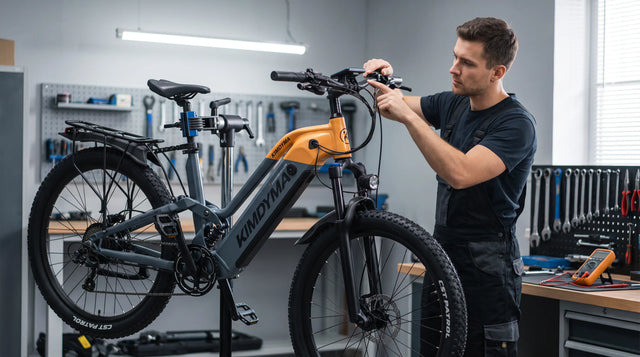
Before each winter ride, take a minute to check:
- Cable routing along the frame, especially near the head tube and fork.
- Brake lines and housings for kinks, rubbing or slack.
- Every visible cable tie for cracks, whitening or movement.
- Connectors near the battery mount and motor for moisture.
Replace cheap plastic ties with proper fixings where cables run near the frame or fork. Clips, cable guides or reusable hook-and-loop straps hold up better when temperatures swing. Do the check indoors, since plastic that is cold is already more fragile.

Storing Your E-Bike and Battery Through the Cold Months
Keep the bike indoors if you can, and always keep the battery indoors. Leaving a bike outside in freezing conditions accelerates wear on the battery, seals and connectors. Moisture gets in, freezes, and slowly works on the parts you do not see. These are the basics of e-bike cold weather care.
If the bike has to stay outside, move the battery indoors from autumn onward and store it at a moderate temperature, neither fully empty nor fully charged. As a general rule, aim for a charge level of roughly 40% to 60%, and keep the pack somewhere cool and dry at normal indoor temperature, away from radiators, direct sun and freezing spots. Many manufacturers give their own figures, so check the manual too. The reason for the middle range is stress. A full battery holds its cells at high voltage, which speeds up unwanted chemical reactions and gradual ageing. A fully empty battery is risky for the opposite reason: it slowly self-discharges, and if the voltage falls too low the cells can be damaged or the battery management system may refuse to wake the pack. Check the level every month or two and top up if it has drifted down. Our charging and storage guide has the details. If you ever need a replacement, a removable pack with a key lock, such as the 48V 20Ah battery, makes the carry-it-indoors habit easy.
After wet, gritty rides, clean up:
- Wipe salt and grit off the chain, cassette and chainring, then lube lightly.
- Rinse the frame gently; do not blast the motor, display or connectors with a pressure washer.
- Dry the battery contacts and the mount before refitting the pack.
Riding Too Fast on Snow, Ice and Gravel: Adjusting Your Technique
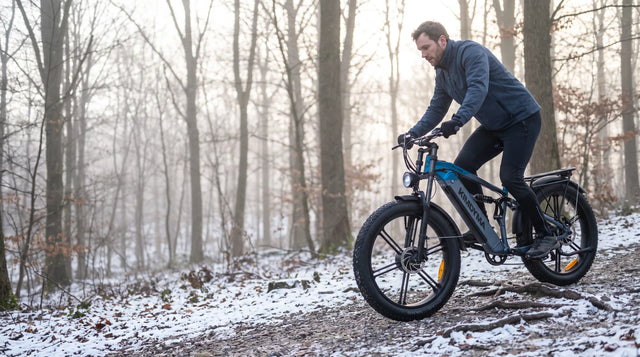
Overconfidence from summer riding is the most common cause of winter crashes. The bike feels the same, but grip is far lower. A trail you rode fast in July can be a different surface after frost, wet leaves or a thin layer of snow.
Adjust your technique:
- Brake earlier and more gently. Braking distances are noticeably longer on frost and wet leaves, and a hard grab can lock a wheel.
- Smooth inputs on steering and throttle or assist, especially on climbs where the rear wheel can spin.
- Consider lower tyre pressure within the tyre's limits for more grip on loose ground.
- Keep your hands working: a pair of windproof touchscreen gloves is a practical way to keep feeling in your fingers so you can still control brakes and shifters. See also our piece on winter gloves and keeping full control.
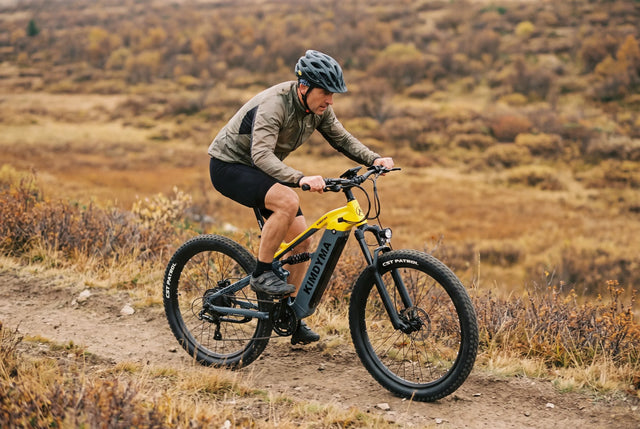
Choose routes by current conditions, not by what you remember. Check forest roads before setting off, because they may be closed, icy in the shade or covered in fallen branches. Our winter route ideas show how to think about gravel and climbs in the cold season. Use lights, since daylight is short; a bicycle lighting setup that is bright and reliable matters more than usual.
Frequently Asked Questions
Can I charge my e-bike battery when it's freezing outside?
It is better not to. Charging a lithium battery below freezing can cause permanent cell damage. Bring the battery indoors and wait until it reaches room temperature before connecting the charger.
Why does my e-bike lose range in winter?
Cold temporarily reduces the usable capacity of lithium batteries. Much of the loss returns once the battery warms up. Lower assist levels and keeping the battery insulated on long rides help you get more distance.
Should I store my e-bike outside during winter?
Avoid it if you can. Freezing temperatures and moisture accelerate wear on the battery, seals and connectors. If the bike must stay outside, take the battery indoors and keep it at a moderate temperature.
Are plastic cable ties safe for e-bikes in cold weather?
Not reliably. Plastic cable ties become brittle in the cold and can snap or slip, which can cause sudden problems with brake or shifter cables. Check them before winter rides and use proper fixings where cables run near the frame or fork.