


An e-bike motor overheats on a long climb when it holds high current for too long, because part of the electrical energy is always lost as heat. Warmth alone is normal; the warning sign is heat combined with a sudden loss of assistance or a temperature message. The fix is to lower assist, pedal more, rest when needed, and rule out dragging brakes or tight bearings before assuming the motor is faulty.
Is a Warm E-Bike Motor Normal, or a Sign of Overheating?
A warm motor is normal; heat combined with a sudden loss of assistance is the real warning. Every electric motor wastes part of the energy it receives as heat, through electrical resistance and other internal losses. So after a long climb, in loaded riding or with a high assist level, the housing will feel warmer than after an easy flat ride. That alone tells you nothing is wrong.
Surface temperature is a poor judge of safety. The casing you touch is not the same as the temperature of the windings inside, and the motor, controller and battery each have their own limits. A hot casing with full power is usually fine. A casing that is only moderately warm but comes with a temperature message is more worrying.
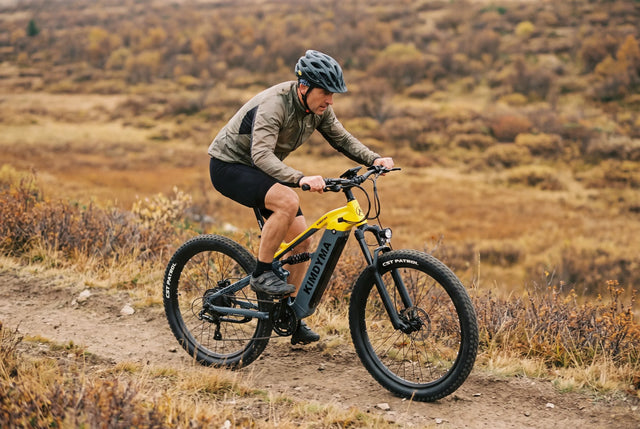
The useful test is to read the whole situation: how hard you were working the motor, whether assistance dropped, whether the display showed a warning, and what your manual says. Where you ride matters too. Mountain riders in the Alpine foothills or on forest tracks load the motor for minutes at a time, so e-bike motor overheating is a real topic for them, not a rare fault.

How the Motor Works on a Climb and Where the Heat Comes From
On a climb, a sensor reads your pedalling, the controller decides how much current to send, and the motor turns that current into drive force; the heat is made in the motor and controller during that conversion. Here is the chain step by step.
- The pedal sensor reports what you are doing. A torque sensor measures how hard you push on the pedals. A cadence sensor (also called a speed sensor) only detects that the cranks are turning and how fast.
- The controller reads that signal. The controller is the electronics box between the battery and the motor. It decides how much current to let through, based on the sensor, your assist level and its own limits.
- The motor receives the current. The windings are coils of copper wire fixed in the motor. When current flows through them they become electromagnets. Their magnetic pull turns the rotor, the spinning part of the motor that carries magnets and ultimately drives the wheel or cranks. A gear reduction, a set of small gears inside a geared motor, slows that spinning and multiplies the force. Think of a low gear on a bicycle: the motor turns several times for each turn of the output, so a small, fast-spinning motor can deliver a strong push at the output. The trade-off is that the output moves more slowly than the rotor does.
- The drive reaches the ground. You feel it as a push that either follows your effort or simply arrives after you start pedalling.
Heat is roughly the cost of current, and the reason is resistance. Copper wire is a good conductor but not a perfect one, so it resists the flow of current a little. Pushing current through that resistance turns some electrical energy into heat, a effect known as Joule heating. The controller's electronics lose some energy the same way. Climbing at low speed asks for high force, high force needs high current, and the heat produced rises faster than the current does, because doubling the current roughly quadruples the heating.
The motor cannot shed that heat as fast as it makes it. Heat leaves only by moving through the metal casing and into the surrounding air, and that path is slow, especially at low speed with little airflow or on a hot day. While heat arrives faster than it escapes, the surplus stays in the windings and temperature builds with time. A short burst may finish before the windings get hot, but a long climb keeps adding heat.
That is why rated and peak power are different things. Rated power is what the motor can deliver continuously. Peak power is a short-term maximum that is only available briefly, because component temperature limits how long it can last. The K01 and K02 are listed at 500 W rated and 1000 W peak. The K03 is 1500 W rated and 2000 W peak across two motors. The M1 is 500 W rated and 750 W peak. Peak figures describe a burst, not a climbing speed you can hold for a whole ascent.
Our bikes show two sensor styles. The K01 and K02 use a torque sensor inside the bottom bracket, so assistance rises and falls with your effort. The K03 and M1 use a cadence sensor, so assistance follows pedalling speed and the assist level rather than how hard you push. On a steep pitch, a torque-sensing bike gives less help when you ease off, while a cadence-sensing bike keeps feeding current at the level you selected. For more on the motor types, see our e-MTB motor guide. A hub motor sits in the wheel, as described in this overview of the wheel hub motor.
Why Long Climbs Push the Motor Hardest: Gradient, Load and Heat
Heat comes from sustained power, so a long climb is harder on the motor than a short, steeper one. A short steep ramp lets the motor use high current for a few seconds and then cool on the flat or the descent. A climb that runs for a long time gives it no chance to recover, and temperature keeps rising.
These factors raise the load:
- Sustained steep gradient: the motor must supply more force for every metre climbed.
- Rider and cargo weight: more mass means more force and more current. The K03 is built for about 200 kg maximum load, but a bike loaded near that figure works its motors harder on every climb.
- Deep sand, mud or soft snow: rolling resistance rises, so the motor is working hard even on a gentle slope.
- Hot weather: the motor starts from a higher temperature and sheds heat more slowly.
Take one imagined climb. Rider A holds the highest assist level in a hard gear at walking pace, and the motor makes high current for the whole ascent. Rider B drops one assist level, shifts down and keeps the cranks turning, so the motor shares the work with the legs. Rider B arrives with a cooler motor and usually still has assistance when Rider A is waiting for a thermal cut to clear.
The maximum gradient ratings are 30% for the K01 and K02, and 35% for the K03. Treat these as the limit of what the bike can climb, not a slope to hold at full assist for a long time. Being able to climb something does not mean the motor can do it indefinitely without heating.

Common Misconceptions About Motor Power and Heat
Most overheating mistakes come from reading one number or one symptom too literally. Four are worth correcting.
"Higher Nm means it can climb hotter for longer"
Torque in newton-metres (Nm) tells you how much turning force the motor can produce. A familiar picture is a wrench on a stuck bolt: Nm is how hard you can twist it. Or think of standing on one pedal to start off on a steep slope; that heavy push is torque. It does not tell you how long it can produce it before temperature becomes the limit. A motor with a higher Nm figure is quoted for a moment of maximum effort. Holding that force means holding high current, so the motor still turns current into heat, and the controller still protects the windings. Instant torque is not the same as sustainable power, and on a long climb the sustainable figure is what counts.
"Nm figures from different motors can be compared directly"
The K01 and K02 list 80 Nm, the K03 lists 85 Nm per motor, and the M1 lists 55 Nm. These figures describe the motor itself, not the whole bike. A geared mid-drive, a hub motor, a two-motor setup and a different sensor type all deliver force differently once gearing, wheel size and software are involved. As an example, take two motors with the same Nm. One drives through a low gear ratio into a small wheel, so the force at the tyre is large and it pulls hard up a slope with little current. The other drives a larger wheel through a taller ratio, so the same motor torque gives less push at the ground and needs more current, and therefore makes more heat, for the same climb. The K03's 85 Nm is also a motor figure, not a torque sensor reading, since it has a cadence sensor.
"If power cuts, keep pushing the throttle"
A heat cut is a protection, not a fault to override. Hammering full throttle through it, or restarting repeatedly, is how windings get damaged. Stop, switch off assistance and let the system cool.
"A hot motor always means a bad motor"
Dragging brake pads, tight bearings or a clogged chain add load, and the motor works harder to overcome them. The symptoms look the same as motor overheating, but the cause is outside the motor. Rule these out first.
Warning Signs: What to Notice, Hear, Smell and Read on the Display
The strongest sign is a sudden fall in assistance on a climb, particularly with a temperature message. A message on the display tells you far more than touching the casing.
-
Assistance drops suddenly: the system may be limiting output to protect itself. This is why an e-bike motor cuts power uphill after a sustained effort. A flat battery, a changed assist level or a sensor fault can feel similar. To tell them apart, work through these checks:
- Read the display. A temperature icon or an error code points to heat protection or a fault. No message means you need the other checks.
- Look at the battery bars. If charge remains, a low battery is less likely. If the bars are nearly empty, the battery is the likely cause.
- Stop pedalling, then restart. If assistance returns normally after a brief rest, a temporary limit is likely. If it stays weak after a rest on level ground, suspect the battery or a fault. If it stays off until the bike has cooled for a while, heat protection is likely.
- Check the assist level. Confirm it has not slipped to a lower setting.
- Hot housing plus reduced power: the combination matters more than either on its own.
- A faint hot-enamel smell: back off assist and stop briefly to cool down.
- Smoke, sparks or a strong burning smell: stop at once, move away from the bike and keep others clear. Do not handle a battery that is hot or smoking. The mechanism behind battery fires is explained under thermal runaway.
- An e-bike motor temperature warning or error code: write down the exact message. Codes differ between manufacturers, so check the manual for your specific model rather than a list for another brand.
How to Ride Long Climbs Without Overheating the Motor
Share the work between your legs and the motor, and give the motor time to cool on long ascents. That is the whole strategy. The details:
- Drop one assist level on steep sections and pedal more. The motor draws less current, and you still keep speed.
- Shift to a lower gear so your cadence stays up. Grinding slowly in a hard gear asks the motor for peak force at low speed, which is its hottest operating condition.
- Rest briefly on very long climbs, especially in warm weather or with a load. A few minutes lets the motor and controller shed heat.
- Never restart repeatedly to override a warning. Cool first.
- Let a fat tyre roll in deep sand instead of holding full throttle. On the K03, tyre pressure in the 0.7–1.7 bar range gives grip and flotation without forcing the motor to push through a dug-in tyre.
On the K01 and K02 you can also use the 5 PAS levels deliberately: use the lower levels for long ascents and keep the higher levels for short steep pitches.
Maintenance Checks That Stop Extra Heat Building Up
Friction anywhere in the system becomes extra load on the motor, so checking for drag is the cheapest way to prevent overheating. Do these before a big climbing day.
- Spin each wheel by hand. It should turn freely and run on for a while. Listen for rubbing from a pad or rotor. Brake noise is covered in our guide to brake ringing at low speed, and wear on pads and rotors in this comparison.
- Check bearings. Roughness or tightness in the hub or bottom bracket adds resistance.
- Keep the chain clean and lubricated, so the motor is not fighting a dry or packed drivetrain.
- Clear mud and debris from the motor and controller surfaces so they can shed heat.
- Check tyre pressure. K01 and K02 run 1.4–2.4 bar, the K03 0.7–1.7 bar and the M1 1.7–2.8 bar. Soft tyres add rolling resistance. Never exceed the sidewall maximum.
When to Stop Riding and Get the Motor Checked
Get the bike checked if it overheats under light load or if warnings keep returning after cooling. Heat on a long, loaded climb is understandable. Heat on flat ground points to drag or an internal fault.
- The motor gets hot, or cuts power, on flat ground or with a light load.
- Warnings come back right after cooling, or heat cuts occur on ordinary climbs.
- You notice a burning smell, discolouration, or any sign of a battery or electrical emergency. Stop and seek help; for battery safety at home, see the NFPA lithium-ion guidance.
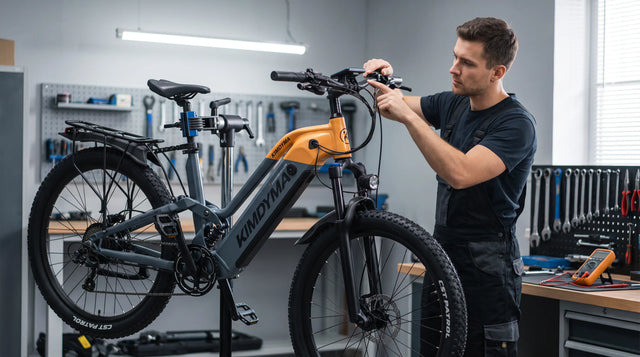
A proper service check should cover brake and bearing drag, the wiring and connectors, the sensor, the controller and the motor itself. On the K01 and K02, the torque sensor sits in the bottom bracket and can be replaced as a spare part. Contact your supplier with the exact error code and a description of when it happens.
Frequently Asked Questions
Why does my e-bike motor cut power on a long climb?
Most e-bike systems reduce or cut assistance when temperatures get too high, to protect the windings and electronics. This is usually a protective response to sustained high current on a steep, long grade. Stop, let the motor cool, and check the display for an error code before riding on.
Is it normal for an e-bike motor to get hot?
Yes. Electric motors convert energy into movement imperfectly and lose some of it as heat, so the motor warms up during normal use, especially on climbs. Warmth becomes a concern when it comes with reduced assistance, a temperature warning, or a burning smell.
Can I keep riding if my e-bike motor overheats?
Not as a rule. Stop, switch off assistance, and let the system cool naturally. Repeatedly restarting to override a heat warning can damage the motor. If the problem returns under normal riding, have the bike inspected.
How can I stop my e-bike motor overheating on hills?
Lower the assist level, pick a gear that keeps your cadence up, pedal more on steep sections, and rest on very long climbs. Also check that the brakes are not dragging and that the wheel bearings run freely, since extra friction adds load that heats the motor.