


Cold temporarily reduces an e-bike battery's range and power, but it rarely causes permanent damage on its own. The habits that cause lasting harm are charging a frozen battery and leaving it fully empty or full in storage. Warm the battery to room temperature before riding and charging, and store it at about 40–60% charge in a cool, dry, frost-free place.
Why Cold Weather Hits an E-Bike Battery Harder
Cold reduces the usable capacity and power of a lithium-ion battery, but the loss is mostly temporary. The cells are not damaged by a cold ride. They simply cannot deliver their full energy until they warm up. This is the main reason e-bike battery cold weather problems feel dramatic on the first kilometres of a winter ride.
Inside a lithium-ion cell, the chemical reactions slow down as temperature falls. That means less energy is available, and you see it as shorter e-bike winter range. Internal resistance also rises, so the battery struggles to deliver high current. You notice this on steep climbs, where the motor asks for the most power and the pack responds with less punch.
Two terms are worth unpacking. Internal resistance is the battery's own "friction": every cell resists the flow of current passing through it. When it is cold, the chemistry inside moves sluggishly, so current has a harder time getting through. Voltage sag is the temporary drop in voltage that happens when the motor pulls a lot of current at once. The higher the internal resistance, the bigger the drop, and the motor, which depends on that voltage, feels weaker.
Think of drinking a thick milkshake through a narrow straw. A slow sip comes up easily. Try to suck hard, and it barely moves. A cold battery is the thick milkshake: gentle riding on the flat is fine, but a steep climb demands a big gulp of current, and the pack cannot supply it fast enough. That is why the bike feels "flat" exactly when you need power most. Once the pack warms, the resistance falls and the strength comes back.
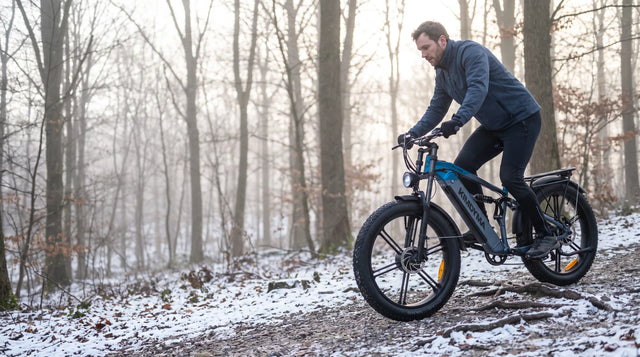
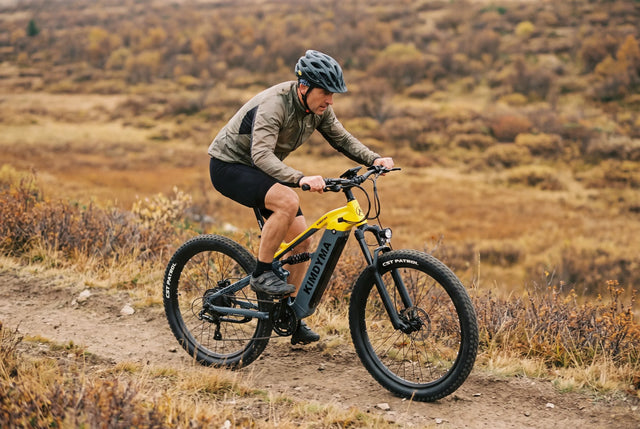
For mountain and gravel riders this matters more than for casual users. Long, steep ascents with a suspension fork and loose surface are exactly where voltage sag shows up first. The good news is that the range usually returns once the pack is warm. The lasting damage comes from how you handle a cold battery, not from the cold itself.

Bring the Battery Indoors Before You Ride
Keep the battery at room temperature until shortly before you leave. A pack that has spent the night in a freezing shed or garage will give noticeably less range than one that starts warm. Take it off the bike, leave it indoors for a few hours, and fit it just before you roll out.
This is easy with a removable pack. If you can, avoid leaving the battery on the bike in a cold garage or in a car overnight. A few practical points:
- Remove the battery after each ride and bring it inside.
- Keep it away from radiators and direct heaters; room temperature is enough.
- Fit it to the bike right before departure, then start gently.
- Carry the bike to the trailhead with the battery inside the cabin, not the boot, if you drive.
Never Charge a Frozen Battery
Do not charge a battery that is below freezing. Charging lithium-ion cells in the cold can cause lithium plating on the anode, which permanently reduces capacity and can raise safety risks. This is the single most important rule for charging an e-bike battery in winter.
In plain terms, when the cell is cold, lithium ions cannot slot into the anode (the negative electrode) quickly enough. Instead, they pile up and settle on its surface as a thin layer of metallic lithium. That layer cannot be undone: the lithium is no longer available to store energy, so capacity drops for good. In severe cases the metal can grow into spikes that pierce the separator inside the cell and cause an internal short circuit.
After a cold ride, the pack is cold even if it feels fine. Let it warm to room temperature before you plug in the charger. Then charge indoors where the temperature is stable, ideally between 10 and 25 °C.
Charging habits matter for safety as well. Damaged or overheated cells can enter thermal runaway, so charge on a hard, non-flammable surface, away from escape routes, and do not leave it unattended for long periods. Thermal runaway is a chain reaction in which an overheating cell heats its neighbours, which then overheat too. It can end in fire or even an explosion, and it is very hard to stop once it begins. The NFPA guidance on lithium-ion batteries is a good home-safety reference. For more on routines, see our guide to making an e-bike battery last longer.
Also use the matching charger. A mismatched unit can push the wrong voltage into the pack, which is a problem in any season but worse on a cold, stressed battery.

Ride Smarter to Keep More Range in the Cold
Use less assist on flats and save the high levels for the steep parts. On a long winter ride, a lower assist level keeps current draw down, which helps a cold pack with higher internal resistance. Plan your effort so the motor does the hard work only where you really need it, such as sustained climbs.
In practice, the first or second assist level is usually enough on flat ground. It feels like a gentle push rather than a shove, and you do a little more of the pedalling yourself. Move up a level only when the road tilts upward, then drop back down on the flat. The reason is simple: the motor's power demand shows up as electric current, and big current is what stresses a cold battery and causes voltage sag. Keeping the current modest means less sag, less strain, and more energy left at the end.
- Assist levels: start low, build up as the pack warms from use.
- Tyre pressure: cold air lowers pressure, which increases rolling resistance. Check it before each ride and adjust for the surface, especially on snow and loose gravel.
- Battery cover: an insulating cover helps retain the warmth produced during discharge. It does not replace warming the battery first.
- Hands and display: numb fingers make you shift and brake badly, and a cold screen is hard to use. A pair of windproof touchscreen cycling gloves keeps your hands warm and lets you operate the display without taking them off.
Keep a margin as well. In winter, plan a shorter loop than your summer range suggests, and choose routes where you can turn back. A simple rule of thumb is to plan the round trip on about half of your remaining charge: when the battery reaches that point on the way out, turn around. Cold, snow and darkness make a flat battery far more inconvenient than in July.
Winter Storage: Keep Charge Level and Temperature in Check
For storage, aim for roughly 40–60% charge in a cool, dry place that stays above freezing. Avoid keeping a pack fully empty or fully charged for long periods, since both extremes stress the cells. The state of charge you leave it at matters more than most riders expect.
If the bike will rest for weeks, check the pack every few weeks and top it up so it never sinks into deep discharge. Deep discharge usually means the charge has fallen to about 0%, or the cell voltage has dropped below its safe lower limit. A battery slowly loses charge even when idle, so a pack left alone through winter can get there. To protect the cells, the battery management system (the protection board) then locks the pack, and that is why a deeply discharged lithium-ion battery may refuse to charge at all. If your battery will not charge after a long rest, this is a likely cause, and it may already have suffered some damage. Our article on storing and restarting an e-bike left unused walks through the full process.
| Situation | Recommended practice |
|---|---|
| Riding season | Store indoors, charge at room temperature |
| Long storage | About 40–60% charge, cool and frost-free |
| After a cold ride | Warm up before charging |
| Storage check | Every few weeks, top up if needed |
When Cold Weather Calls for a Replacement Battery
If range stays sharply reduced even after the pack has warmed up, the battery may be worn or damaged. Other warning signs are swelling, a case that feels unusually hot, or failure to charge. Stop using a swollen pack and do not try to charge it.
A second pack can also make winter riding easier. A removable 48V 20Ah battery with a key lock lets you keep one pack indoors, warm and charging, while you ride on the other. That suits riders who do long mountain days or want a spare for cold mornings.
Before you buy, check that the voltage, connector and charger match your bike, and that the pack is in good condition. Cheap, unbranded cells are a poor bet in winter, when the battery is already under strain.
Frequently Asked Questions
Can I charge my e-bike battery when it's cold?
Avoid it. Charging a lithium-ion battery below freezing can cause lithium plating, which permanently reduces capacity. Let the battery warm to room temperature after a cold ride, then charge it indoors.
Why does my e-bike lose range in winter?
Low temperatures reduce the usable capacity of lithium-ion cells and increase internal resistance. In most cases the range comes back once the battery warms up, so the drop is usually temporary.
How should I store an e-bike battery over winter?
Keep it at around 40–60% charge in a cool, dry place that stays above freezing. Check it every few weeks and top it up, so it never sits fully empty for long.
Do battery insulation covers help in cold weather?
They help retain the heat the battery produces while discharging, which slows how quickly it cools during a ride. They work best when the battery is already warm, so they do not replace warming it first.