


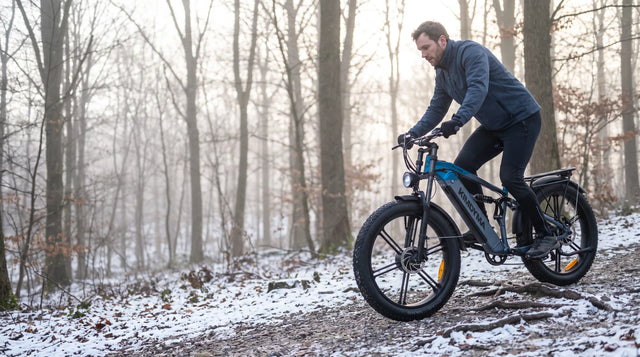
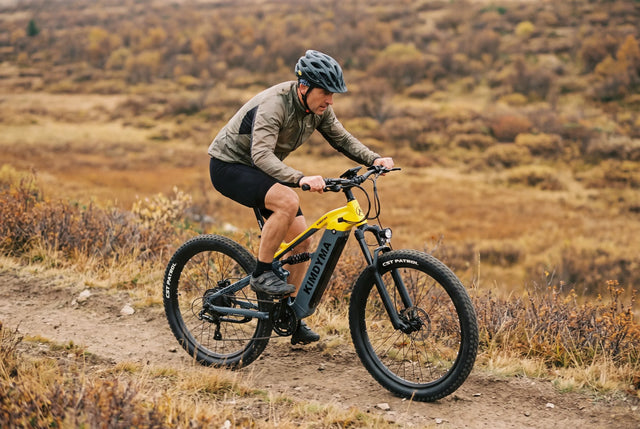
The best winter e-bike routes in the Black Forest are shorter loops on well-maintained gravel and forest roads, with moderate sustained climbs under about 10% and a clear bailout option. Avoid long, exposed ascents on icy shaded tracks, and check seasonal closures before you ride. A mountain e-bike with a 150mm fork and 30–35% climbing capacity handles these surfaces well.
What Makes a Black Forest Route Suitable for Winter E-Biking?
A good winter route is one you can shorten or abandon at any point. When you plan winter e-bike routes in the Black Forest, daylight, battery temperature and surface grip matter more than total distance. A loop that feels easy in July can turn into a cold, slow slog after dark in winter.
Winter changes three things at once. Days are short, so your margin for a mechanical or a wrong turn is small. Cold batteries deliver less usable capacity. And wet leaves, packed snow and frost make the same track behave very differently from summer.
Prioritise routes with a way out
- Choose shorter loops rather than long out-and-back routes deep in the hills.
- Look for routes that cross or run close to public roads, villages or bus stops, so you can cut the ride short.
- Favour lower-elevation options in the valleys and foothills when conditions are uncertain. Higher, shaded ground holds ice longest.
Read the surface, not just the distance
Distance tells you very little in winter. Read the route description for surface type: compacted gravel, asphalt, loose stone, singletrack, roots or rock. Check which slopes face south and which sit in shade, since shaded sections are where ice lingers.
If a description only gives kilometres and elevation, look at satellite imagery and recent rider reports before you commit. When in doubt, pick the route with more hardpack and fewer roots.

How to Choose Climbs for Cold-Weather Riding
For winter, favour climbs that are steady and moderate, ideally under about 10%, over ones that are long and exposed. Black Forest e-bike climbs vary enormously, so judge each one by gradient, length and surface together. A long, steady climb keeps drawing power for a long time, which is harder on a cold battery than a short steep pitch that you clear quickly.
Gradient versus sustained length
A steady 8–10% climb that lasts a long time pulls current continuously, and a cold pack sags more under that load. A short, steeper pitch is over in a minute or two. For range planning, the total time spent climbing matters more than the single steepest gradient on the map.
Why does a cold pack sag? Cold raises the battery's internal resistance. Think of it as a narrower pipe: the harder you pull, the more voltage is lost on the way out. Sustained current keeps that loss going, and the controller may cut power early when the voltage dips. A short steep pitch is brief, and the pack recovers on the flat afterwards.
I can't give a reliable figure for how much range you lose, because it depends on temperature, the state of the battery and how hard you ride. Measure your own instead: ride the same loop in mild weather and in the cold, note the battery percentage used per hour of climbing, and compare. As a rough guide, if two routes gain the same height, the longer, gentler one usually costs more charge, because the motor works for more minutes. Plan on that margin.
Match the climb to the bike
The rated maximum climbing ability of our bikes is 30% for the K01 and K02, and 35% for the K03 with its dual motors. These are ceilings in good traction conditions, not winter targets. On frost, wet clay or loose gravel, the limit is usually your tyres, not the motor.
In practice, treat steep winter pitches as something to walk or take slowly. If you are loaded up or riding something like the K03 Ranger with fat tyres, you get more grip and torque in reserve, but the same caution on ice still applies.
Use assist levels to manage range
- Start climbs in a lower assist level and step up only when needed.
- Keep a steady cadence rather than grinding in a high gear, which wastes energy.
- Save your highest assist for the last steep section or for getting home.
Expect e-bike winter range to be noticeably lower than in summer, and plan your loop with that in mind rather than relying on a summer figure.
Gravel and Forest Roads: What to Expect in Winter
Compacted gravel is the most reliable winter surface; loose stone and root sections are the least. An e-mountain bike on gravel and forest roads is a good fit for the Black Forest in winter, because wide tyres and a suspension fork absorb the frozen ruts and washouts that are common this time of year.
How surfaces change in frost
- Compacted gravel: firm and predictable when cold, but can be glassy where meltwater has refrozen.
- Loose stone: shifts underfoot and under tyres; braking distances grow.
- Roots and rocks: slick when wet or frosted, and the least forgiving on climbs.
- Mud and leaf litter: hides ruts and holes, so slow down on descents.
Tyre pressure and fork setup
Slightly lower tyre pressure improves grip on cold, hard or slippery ground, but not so low that you risk pinch flats or rim damage. Adjust in small steps and test on a safe stretch first.
For rough descents, set your fork sag properly so it tracks the ground rather than skipping over it. Our step-by-step guide to fork air pressure and sag setup covers the process.
Why 150mm of travel earns its place
On the K02, the 150mm fork matters most on rutted, frozen forest tracks. It smooths out the hard, uneven ground that tires your hands and arms, and it keeps the front wheel in contact when you hit a frozen rut. That means better steering control on a descent, which is where winter mistakes usually happen. For wet-weather line choice, our autumn wet-weather line guide applies equally well in winter.

Forest Road Access, Closures and Safety Checks
Always check access before you leave, because not every forest road is open in winter. Seasonal closures happen for logging, wildlife protection, snow clearance or private land, and a closed barrier at the top of a long climb is a bad surprise.
Before you go
- Check local signage and regional forest authority notices for the area you plan to ride.
- Look for private-road restrictions and respect them.
- Remember that a pedelec follows the rules of the road in most of Europe, as described in the Pedelec overview, so stay on permitted tracks.
Carry for short daylight
Take a front light even if you plan to finish before dusk; a rechargeable unit like this 400 lm USB-C front light is easy to keep topped up. Add a basic kit: spare tube or plugs, a pump, multitool, and a warm layer. Make sure the battery is fully charged at the start.
Tell someone and set a turnaround
Tell someone your route and expected return time. Set a hard turnaround time, based on sunset rather than on how far you have got. If you reach that point, turn back even if the summit is close.
Preparing Your E-Bike and Battery for Cold Rides
Keep the battery warm before and between rides, and charge it indoors. Cold slows the chemical reactions inside lithium-ion cells, which is why usable capacity drops in low temperatures. The capacity is not lost, but you cannot access all of it until the pack warms up.
Keep it warm, charge it indoors
The effect starts to matter as temperatures approach freezing and becomes stronger below it. Above that, a pack stored indoors usually needs no special care. Once it is near or below freezing, take the steps below.
- Store the battery indoors overnight and fit it just before you leave.
- If your battery is removable, keep it inside your jacket or a bag until the moment you ride off, and warm it the same way at stops.
- Avoid leaving the bike parked for a long time with the battery exposed, such as at a café stop.
- Do not charge a freezing-cold pack straight away; let it reach room temperature first.
- Charge on a hard, non-flammable surface, away from anything combustible, and do not leave it charging unattended. The risks of overheating and thermal runaway are low but real, and the NFPA lithium-ion guidance is a useful reference.
- Use the correct charger for your pack, such as the 48V 4A charger made for our bikes.
Expect the gauge to move during a ride. Riding warms the pack through its own heat, so a reading that fell at the start can recover. After a long stop in the cold it will sag again.
To tell cold from ageing, compare readings: if range is back to normal on a mild day with a warmed pack, the drop was just the cold. If range is still clearly down in mild weather after a full charge, the battery may be wearing out.
For longer breaks, see our advice on storing and charging for longer battery life.
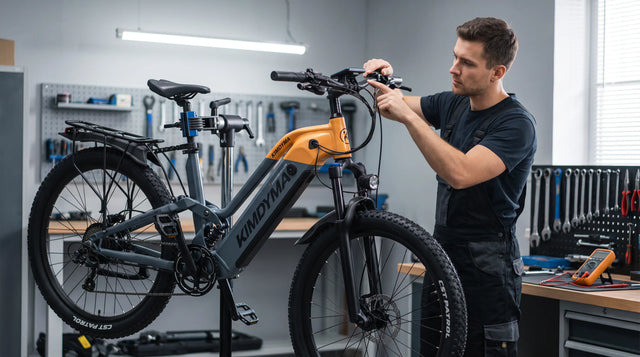
Check brakes, lights and mud protection
Test both brakes before you leave, looking at pad wear and lever feel, because wet and gritty conditions wear pads quickly. Check that front and rear lights work and are secure. On wet, muddy tracks, a set of adjustable front and rear mudguards keeps spray off your face and drivetrain, which is a practical addition for winter.
Finally, set tyre pressure for the surface you expect, and wipe down and lube the chain after muddy rides so it is ready next time.
Frequently Asked Questions
What is the best type of route for winter e-biking in the Black Forest?
Shorter loops on compacted gravel and forest roads, with sustained climbs below about 10% and a clear turnaround point. These keep you in lower, more sheltered valleys and make it easier to finish before daylight fades.
Does cold weather affect e-bike range on mountain climbs?
Yes. Cold reduces usable battery capacity, and long climbs draw more power. Plan for a lower range than in summer, keep the battery warm before riding, and use lower assist levels on long ascents to conserve charge.
Are forest roads in the Black Forest open all year?
Not always. Some forest roads and tracks have seasonal closures or restrictions, especially for logging or wildlife. Check local signage and regional forest authority notices before setting out.
What should I check on my e-bike before a winter ride in the Black Forest?
Charge the battery indoors, check tyre pressure for the surface, test brakes and lights, and fit mudguards for wet conditions. Carry a charged light and a basic repair kit, since daylight is short.