


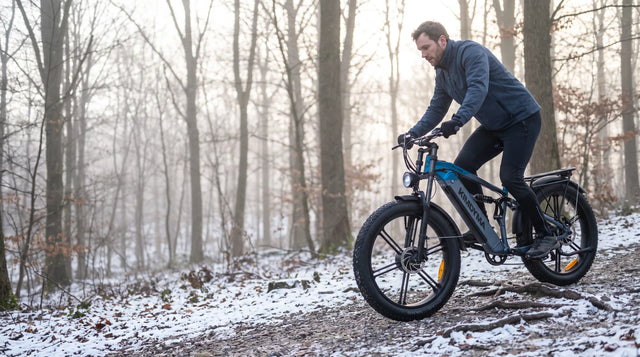
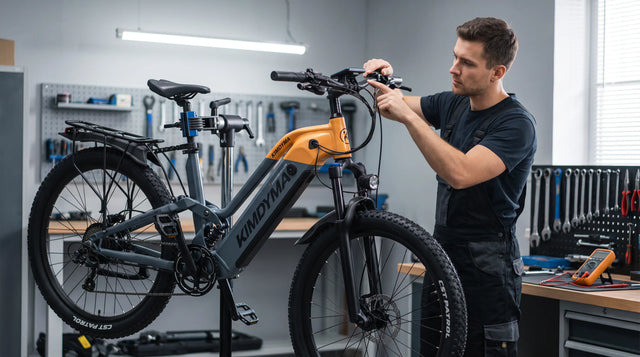
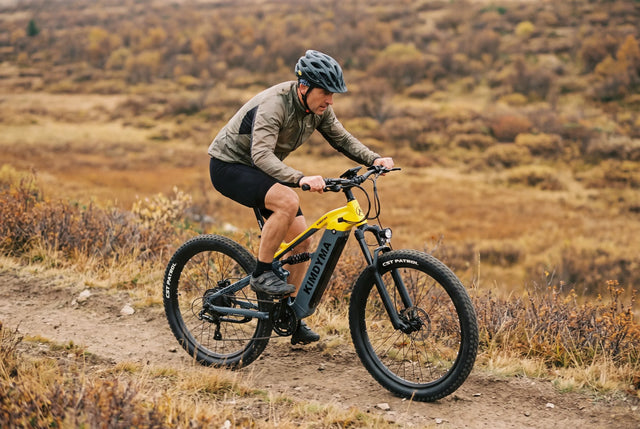
A torque sensor measures how hard you push the pedals and sends that signal to the motor controller, which adds assist in proportion to your effort. A cadence sensor only detects that the crank is turning and switches on a preset power level. Because assist follows force rather than just pedal speed, torque-sensing e-bikes usually feel more continuous and bike-like underfoot, especially when climbing or accelerating from a stop.
How a torque sensor turns your pedal force into motor assist
A torque sensor e-bike converts the force of your legs into an electrical signal, and the motor controller turns that signal into motor output. The chain has five links: your foot pushes the pedal, the crank and spindle flex or twist by a tiny amount, the sensor measures that load, the controller reads it, and the motor drives the wheel. Your effort sets the starting point, so the assist you feel is built from it.
A torque sensor is a component that measures how hard you push, in newton-metres, rather than whether the pedals are moving. Two designs are common. A strain gauge is a thin foil element whose electrical resistance changes when it is stretched or compressed, so a pedal push becomes a measurable voltage change. A magnetoelastic design reads how the magnetic field around a loaded shaft shifts as the shaft is stressed. Both can sit in the bottom bracket or at the rear dropout.
The assist level (PAS) is the setting you pick on the display, for example eco or sport. It decides how much the controller multiplies your measured effort. The controller is the small computer between battery and motor; it takes your force reading and the PAS setting and sends a matching current to the motor.
The sensor takes many readings during every pedal stroke. That is why assist swells as your leg drives down through the stroke and eases as it passes the dead spot, instead of staying flat. On a steep loose climb, a hard push gets a strong response and a light push gets a light one, so you can modulate traction with your legs.

Cadence sensor vs torque sensor: what changes under your feet
The core difference is what each sensor reports: a torque sensor reports force, a cadence sensor reports only that the crank is rotating. A cadence sensor typically uses magnets on a disc near the crank. Once it has seen the crank turn through roughly an eighth to a quarter of a rotation, it tells the controller to deliver the preset power for the chosen PAS level, regardless of how hard you push.
The mechanism is simple counting. A disc fitted with several small magnets turns with the crank, and a fixed pickup beside it produces a short electrical pulse each time a magnet passes. The controller does not need much to decide you are pedalling: a few pulses in a row, or a single pulse arriving after a short gap, is enough. Because the magnets are spaced around the disc, that first pulse arrives after only a small part of a turn, which is where the eighth to a quarter of a rotation comes from. The pulses carry no information about force. They only say "the crank moved" and, from the spacing between them, how fast.
The "preset power" is a target tied to the PAS level, not to your legs. Each level corresponds to a fixed share of what the motor can deliver, and the higher levels give larger shares. Once the controller sees pedalling, it ramps toward that share whether you are pressing lightly or pressing hard. Pedal with almost no effort at a high level and you still get the same large output. This is what "independent of pedal force" means in practice, and it is why the assist can feel like a shove: the motor goes from nothing to a set value on the strength of a few magnet pulses, without any reading of what your legs are doing.
The consequence is easy to picture on a short, steep pitch. With a cadence sensor, half a pedal turn can bring the full preset assist, and that surge can break rear-wheel traction on loose gravel. With a torque sensor, the same pedal speed with a gentle push gives a gentle response, so you can feather the power through the slippery section. The torque sensor vs cadence sensor choice is therefore mostly about control at low speed and on poor surfaces.
| Dimension | Torque sensor | Cadence sensor |
|---|---|---|
| Pedal feel | Assist rises and falls with each push; feels like extra leg strength | Assist arrives at a preset level once the crank turns; can feel like a push from behind |
| Low-speed control | Light pedalling gives light assist, useful in tight turns and technical sections | Short delay, then a set output; harder to meter on loose or rooty ground |
| Climbing | Push harder and the motor adds more without touching the display | Output is fixed per level, so you change level to change help |
| Battery efficiency | Assist follows effort, so less is wasted on easy sections | Motor delivers the preset level even when you could do without it |
| Maintenance | Extra precision component to service or replace over time | Simple magnet and pickup; few parts to fail |
| Typical price band | Generally found on higher-priced bikes | Generally found on lower-priced bikes |
| Best suited to | Riders who want bike-like response and fine control on trails | Riders who want easy, consistent help with little effort, or have limited leg strength |
What an assist curve actually does to the ride
An e-bike assist curve is the mapping from rider input to motor output at each PAS level, and its shape decides whether the bike feels smooth or abrupt. Think of it as a rule: "for this much input, give this much output, and ramp up this quickly." A gentle curve climbs gradually, so the motor blends in as your effort grows. An abrupt curve jumps quickly to high output, which feels jerky even if the peak figure is the same.
A simple example makes the difference concrete. Treat your pedal force as a scale from 0 to 100 percent, and the motor output as a scale from 0 to 100 percent of what the chosen PAS level allows. On a gentle, linear curve, 25 percent of your input gives about 25 percent output, 50 gives about 50, and 100 gives 100. The output rises in step with you. On a steep curve, 25 percent of your input might already give around 60 percent output, and by 50 percent input the motor is near its ceiling. Both curves end at the same maximum, but the steep one delivers most of the help in the first part of your effort, so a modest push produces a big reaction and there is little room left to fine-tune between "a bit" and "a lot".
The same hardware can therefore feel quite different, and two separate settings are responsible. Sensitivity decides the starting point: how small a pedal force the system notices at all, and so where the curve begins. Curve slope decides what happens after that: how quickly output grows as the force increases. Controller tuning also sets how fast output ramps and how quickly it fades when you ease off. A very sensitive sensor with a steep curve will react to every twitch of your foot; a less sensitive one with a soft curve will feel calm but a little slower. Raising sensitivity does not make the curve steeper, and steepening the curve does not make the sensor notice lighter touches.
On a rooty climb, the difference is concrete. A soft curve lets you roll over a root with a small effort bump and no surge. A steep curve may add a burst of power just as the front wheel unloads. If your display allows adjustments, our guide on tuning assist response on an e-MTB display covers what to change first.

Where Kimdyma's torque-sensor and cadence-sensor models sit
Within our range, the sensor type follows the model, and each suits a different kind of riding. The TITAN X K01 and the AURORA S K02 use a torque sensor inside the bottom bracket, paired with a 500W rated (1000W peak) gear motor producing 80 N·m. Both carry a 150 mm travel fork, so the sensor's fine control suits technical climbs and loose surfaces.
The K03 RANGER and K05 FIRN use a cadence (speed) sensor. The K03 has dual motors rated at 1500W (2000W peak) with 85 N·m each; the K05 has a single 750W rear hub motor at 60 N·m. The M1 ARETE also uses a speed (cadence) sensor, with 500W rated and 750W peak at 55 N·m. With these bikes, the motor delivers the preset level for the chosen PAS setting, which suits heavy loads, fat tyres on snow or sand, and riders who prefer steady help.
Note that "85 N·m" on the K03 is motor output, not sensor type. A hub motor with high torque still follows a cadence signal on that bike. This section is not a ranking: it describes what each sensor does for the rider.
Three common misreadings of torque and assist numbers
Most confusion comes from reading one number on a spec sheet as if it described the whole ride. These are the three mistakes we see most.
- "Higher Nm means a better-feeling bike." Nm describes the maximum turning force the motor can produce. It says nothing about how much of that force the controller chooses to release at a given moment. The controller combines two things: the signal from the sensor, which says how hard you are pushing, and the assist curve, which says how much of the motor's capability to request for that push. Take two bikes with the same 80 N·m motor. On the first, a soft curve asks for about a third of the motor's capability at moderate effort, and output grows in step with your leg, so the bike feels like a strong tailwind. On the second, a steep curve asks for most of the capability at the same effort, so the same push triggers a surge and the bike seems to leap forward. The motor is identical, but the request sent to it is not. That is why similar Nm can feel very different.
- "Torque sensor and motor torque are the same thing." They are different parts. The sensor measures you; the motor figure describes the machine. A bike can have a strong motor and a cadence sensor, or a modest motor and a torque sensor, so the two figures should not be compared directly.
- "A torque sensor can't feel abrupt." It can. If the assist curve is steep or the PAS level is high, a modest push produces large output, and the bike still lurches. Sensor type gives you the potential for smooth delivery; tuning decides whether you get it.
How to judge pedal feel on a test ride
You can judge a torque sensor e-bike or a cadence bike in ten minutes if you repeat the same few tests on each bike. Use this order:
- Standing start on a slight incline. Pedal lightly, then hard. Notice whether assist scales with your push or arrives at one level regardless.
- Check lag at PAS 1 and PAS 3. Count how far the crank turns before you feel help. A delay of a fraction of a turn is typical of cadence sensing.
- Stop pushing mid-stroke. Feel how quickly assist fades. A bike that keeps pushing after you ease off is harder to place precisely on trails.
- Ride a tight loop at walking pace. Torque sensing should let you creep with small inputs; a surging bike will fight you.
- Take a rooty or loose gravel section. Watch for rear-wheel spin as you apply power over uneven ground.
- Change PAS levels while riding. See how much each step changes the feel, and check whether the display lets you adjust response.
Does a torque sensor help range and battery life?
In principle yes, because motor output follows your effort, so less assist is spent where you did not need it. On a rolling route where you can ease off on flats and push on climbs, a torque sensor lets the motor do the same. A cadence system gives the preset level whenever you pedal, so it uses more energy on easy sections.
Real range still depends on terrain, rider weight, the PAS level you choose and the state of the battery. A cold or aged pack delivers less, regardless of sensor type. For maintenance habits that protect capacity, see our article on making an e-bike battery last longer. For background on how the cells store energy, see this overview of lithium-ion batteries.
Frequently Asked Questions
What is the difference between a torque sensor and a cadence sensor on an e-bike?
A torque sensor measures how hard you push on the pedals and scales motor assist to match. A cadence sensor only detects whether the pedals are turning and then delivers a preset power level for the chosen assist setting. Torque sensing usually feels more natural and responsive to effort, while cadence sensing is simpler and often cheaper.
Does a torque sensor make an e-bike feel more natural?
In most cases yes. Because motor output rises and falls with your pedal force, the bike responds in a way that resembles a traditional bicycle with extra help. Cadence systems can feel abrupt because they engage at a set power once the crank turns. How natural it feels also depends on the controller tuning and the assist level you select.
Is a higher motor torque in Nm the same as a better torque sensor?
No. Motor torque in Nm describes the maximum turning force the motor can deliver. A torque sensor is the component that measures rider input. A bike can have a high-Nm motor with a cadence sensor, or a lower-Nm motor with a torque sensor. The two specifications describe different parts of the system and should not be compared directly.
Do torque sensor e-bikes use less battery?
They can, because the motor only adds power when you apply force, so less assist is wasted on easy sections. Actual range still depends on terrain, rider weight, the assist level you use and the condition of the battery. Torque sensing improves efficiency in principle, but it is not a guarantee of longer range on every ride.