


A derailleur is cheaper, lighter and easier to service yourself, but its chain and cassette need regular cleaning and adjustment. A Pinion gearbox sits at the bottom bracket, offers a very wide internal range, can shift at a standstill, and usually runs a belt drive that needs little cleaning. It still needs periodic oil service. For steep, loaded climbs and low-maintenance riding, a gearbox usually wins; for lowest weight and the most familiar service, a derailleur stays the practical choice.
How a Derailleur and a Pinion Gearbox Actually Work
In the pinion vs derailleur e-mtb debate, the core difference is where the gear change happens: a derailleur shifts the chain between exposed sprockets at the rear wheel, while a Pinion gearbox changes ratio inside a sealed housing at the bottom bracket. Everything else, from weight to maintenance to feel, follows from that one layout choice.
A derailleur is a spring-loaded arm that pushes the chain sideways from one cog of the cassette (the stack of rear sprockets) to the next. You move a shifter, a cable or an electronic signal moves the arm, and the chain climbs onto a bigger or smaller cog. The mechanism hangs off the frame near the rear axle, so it sticks out and can be hit by rocks, branches or a fall.
A Pinion gearbox puts a gear train in a sealed case around the crank area. A gear train is simply a set of meshing toothed wheels. Inside, different combinations of gears are engaged or locked together, and each combination gives a different ratio between your pedals and the output sprocket. When you twist the shifter, the gearbox changes which gears are engaged. Nothing moves across the outside of the bike, and the gears run protected from mud and water. The rear wheel then needs only one fixed sprocket, and many gearbox bikes pair that with a belt drive, a toothed reinforced belt that replaces the chain.
The belt works differently from a chain. Its molded teeth mesh with matching teeth on the front and rear pulleys, so it pulls the wheel round by engagement, much like a gear. A chain has metal rollers and pins that rub against each other and need lubricant. A belt has none of those parts, so it does not need oiling, and there is no greasy chain to clean or lengthen.
A few terms matter from here on:
- Gear range: the spread between your easiest and hardest gear, often expressed as a percentage. A bigger spread means a lower climbing gear and a higher top gear.
- Gear step: the jump in ratio from one gear to the next. Small, even steps let you hold your preferred cadence; big steps make you spin too fast or grind too slowly after each shift.
- Reduction ratio: how many times the pedals turn per wheel turn. A low gear has a large reduction, so the wheel makes only a small part of a turn for each full crank turn. That works like a longer lever: each pedal stroke needs less force, but the bike rolls only a short distance. In a high gear the wheel turns many times per crank turn, so one pedal revolution carries you much further but demands more force. This is also why cadence and speed are linked: at the same cadence, a low gear gives a slow roll and a high gear gives a fast one.
- Shifting under load: changing gear while pushing hard on the pedals. Both systems prefer a brief easing of pedal pressure during the shift.
The gearbox also moves transmission weight to the middle of the bike, close to the centre of gravity. On a steep, rough descent or a loaded climb, mass that sits low and central makes the bike feel more settled than the same mass hanging at the rear axle. A derailleur keeps the frame lighter in the middle, but the cassette and mechanism sit at the wheel.

Side-by-Side: Gear Range, Gear Steps and Climbing Ability
For e-mtb gear range, the published comparisons favour the gearbox: one gear-calculator analysis lists a spread of 636% for the Pinion P1.18 against 450% for a Shimano GRX 1x12 setup. That extra spread shows up as additional climbing gears and additional descending gears, with very even increments in between.
The percentage comes from dividing the ratio of the hardest gear by the ratio of the easiest gear. So 636% means the top gear is roughly six and a third times as tall as the lowest, or put the other way, the lowest gear asks about one sixth of the effort per pedal stroke. The 450% figure means the GRX top gear is about four and a half times its lowest. On a steep ramp, that gap means the wider-range bike lets you keep turning the cranks at a comfortable cadence where the narrower one leaves you grinding.
Why does range matter? Picture a loaded climb on a loose, steep track. Your motor helps, but if your easiest gear is still too tall, you either labour at a low cadence or you lean on the motor hard and drain the battery. An extra low gear lets you keep turning the pedals smoothly, which also helps the rear tyre keep traction instead of spinning.
Step evenness matters on the flats. With wide jumps, a single shift makes your cadence drop suddenly or spike, and you have to adjust your legs to a new rhythm. With even steps, each shift changes cadence only slightly, so the rhythm is easier to keep. A tightly stepped cassette lets a fast rider move one small notch and keep the same cadence. Those same sources note that a typical 1x12 derailleur has wider jumps in its high gears, which is where you spend time at speed, while the gearboxes keep steps even across the range. However, a gearbox has a fixed internal spread, and some gearbox configurations have noticeably larger jumps than a close-ratio performance cassette. If you hold a precise cadence at speed, check this before you buy.
| Dimension | Derailleur (1x12) | Pinion gearbox |
|---|---|---|
| Range | Narrower; 450% in the GRX example | Wider; 636% for P1.18 in the same comparison |
| Step evenness | Jumps grow wider in the high gears | Even steps across the range on the models compared |
| Climbing gear | Depends on cassette and chainring choice | Extra low gears over the compared derailleur setups |
| Top-end gear | Set by chainring and smallest cog | Extra high gear on the compared C1.12 and P1.18 |
| Shifting under load | Easing off pedal pressure recommended | Brief reduction in torque also advised |
| Shifting at standstill | Not possible; restart in the gear you stopped in | Possible on many configurations |
| Weight | Lighter | Heavier, slightly less efficient |
| Price tier | Lower, widely available parts | Higher, specialist component |
| Best for | Fast flowing trails, easy home service | Steep, loaded or stop-start climbing, low cleaning |
If you want to understand how motor output interacts with gearing, our guide to e-MTB motors, torque and range covers the other half of the climbing equation.
Maintenance: What You Actually Do Over a Year
On pinion gearbox maintenance, the honest answer is that you swap frequent small jobs for rare specialist ones. A derailleur bike asks for regular attention; a gearbox bike asks for less, but it is not zero.
Derailleur routine
- Clean and lubricate the chain regularly, more often in mud, sand or wet weather.
- Measure chain wear with a checker. One retailer advises replacing the chain at the 0.75 mark, so that roughly three chains wear out before the cassette does.
- Watch the cassette and chainring for wear, and adjust the indexing when shifts get hesitant.
- Check that the derailleur hanger, the small replaceable tab that holds the derailleur, is straight after any impact.
Pinion routine
- Change the gearbox oil at the interval the manufacturer specifies.
- Inspect belt condition and tension, and clear debris from the belt path.
- Enjoy the sealed housing: there is no exposed mechanism to bend, and the chainline stays single.
The e-bike belt drive vs chain question is part of this. A belt does not need lubricating or cleaning like a chain, but it still has to be checked. A chain is cheap and easy to fix on the trail; a belt usually needs the right parts and some know-how.
| Task | Derailleur | Gearbox with belt |
|---|---|---|
| Routine cleaning | Frequent, chain and cassette | Minimal |
| Typical wear points | Chain, cassette, chainring, derailleur | Belt, sprockets |
| Shop visit needed | For complex adjustment or electronic setup | For oil service and gearbox faults |
| Impact vulnerability | Exposed derailleur can bend | Sealed housing is better protected |

Common Myths About Gearboxes and Derailleurs on E-MTBs
Four assumptions lead riders to the wrong drivetrain, and each one fails for a clear reason.
Myth: a wider range always means faster climbing
Range only sets the lowest gear you could use. Whether you can use it depends on your cadence, how much torque the motor adds and how much grip the tyre has. A very low gear on a slippery climb is useless if the rear wheel spins, and it adds nothing if the motor already gives you enough help in a mid gear.
Myth: derailleurs always shift faster
A good derailleur, especially an electronic one, shifts quickly while you pedal. But shift quality depends on load and on the specific system. A derailleur shifted under heavy torque can be noisy, hesitate and wear faster, and some gearboxes allow several gear changes in one twist.
Myth: belt drives never need attention
A belt avoids lubricant, but grit trapped between the belt and sprocket can damage it, and tension needs checking. Treat it as low-maintenance, not no-maintenance.
Myth: ratio numbers can be compared directly
A gear's real ratio depends on the chainring or front sprocket and the rear sprocket. The gearbox examples in the sources use set sprocket pairs, such as 32T front with 24T or 30T rear, while the derailleur comparisons use chainrings of 32T, 36T or 40T with large cassettes. Always check these sizes before comparing two bikes.
How to Choose: A Checklist for Your Riding
- Write down where you ride most. Steep loaded climbs and stop-start technical sections favour a gearbox; fast flowing trails with constant cadence changes favour a close-stepped derailleur.
- Decide what you will service yourself. If you enjoy cleaning a chain and adjusting indexing, a derailleur suits you. If you prefer fewer routine jobs, a sealed gearbox appeals.
- Check your distance from a qualified workshop. Gearbox oil service and belt work are specialist tasks, so a distant shop makes a derailleur more practical.
- Confirm the actual ratios. Ask for the gearbox model, the front and rear sprocket sizes, and the chainring options, then work out your lowest gear.
- Compare published range and step data rather than marketing claims, and ask the dealer which setup suits your motor and frame.
- Test ride on a hill. Stop on a steep section, then try to restart, and notice whether you can select a lower gear before moving away.
Brakes also take serious punishment on steep terrain, so read which wears first on steep descents as part of your planning.
Kimdyma Models: Which Drivetrain Suits Which Rider
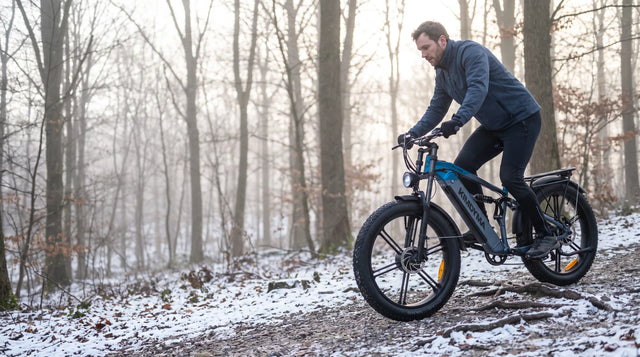
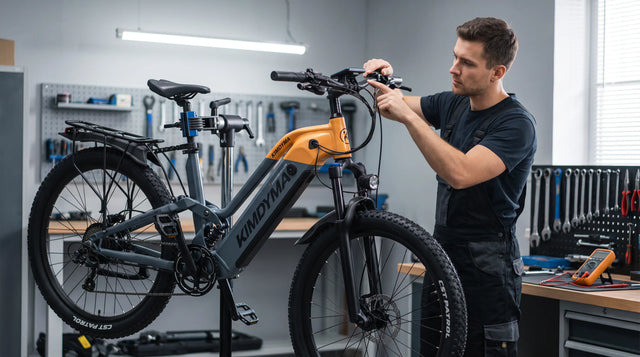
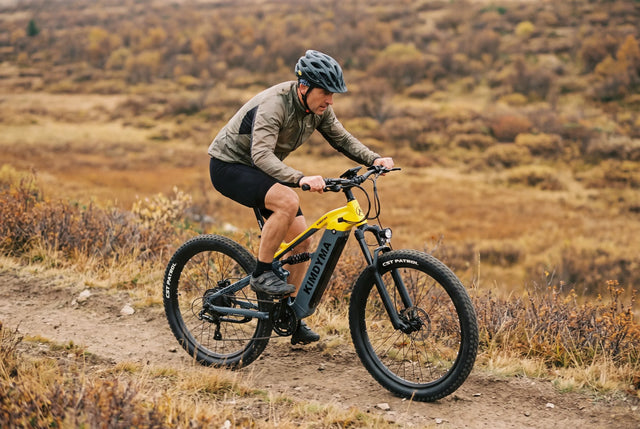
None of the Kimdyma models in the spec sheets uses a Pinion gearbox: all five use conventional chain-and-derailleur drivetrains. For these bikes, the question is which derailleur setup and motor fit your terrain.
- TITAN X K01: 9-speed (21-speed option) Shimano TX30/TZ500 with a 42T chainring, an 80 N·m torque-sensing motor and 150 mm of fork travel, for riders of 178-190 cm.
- K02 AURORA S: the same platform in a step-through frame for riders of 158-178 cm, suited to mixed-surface routes where an easy step-over matters.
- K03 RANGER: 7-speed, dual motors and 26" x 4.0" fat tyres, with a maximum load of around 200 kg for loaded, all-terrain use.
- K05 FIRN: Shimano 7-speed, fat tyres and full suspension at 30 kg, for sand, snow and gravel.
- M1 ARETE: Shimano 7-speed, full suspension and 27 kg with battery, the lightest in the range.
Drivetrain options can vary by sales configuration, so check the spec sheet for the exact gear set on the bike you are buying. For torque figures and how they relate to climbing, see why raw torque numbers can mislead.
Frequently Asked Questions
Is a Pinion gearbox better than a derailleur on an e-MTB?
It depends on the riding. A Pinion gearbox offers a wider internal range, shifting at standstill and a belt drive that needs little cleaning, which suits steep climbs and low-maintenance use. A derailleur is lighter, cheaper and easier to service yourself, and gives you tighter gear steps on fast trails.
Do Pinion gearboxes need maintenance?
Yes. A gearbox is not maintenance-free. It needs periodic oil service at the interval the manufacturer specifies, plus belt tension and condition checks. You trade the frequent chain cleaning and derailleur adjustment of a derailleur for less frequent but specialist service work.
Can you shift a Pinion gearbox while stopped?
On many Pinion configurations you can select a gear while stationary, which helps at traffic lights and on steep stop-start climbs. Check the specific gearbox model and control system, as capability varies.
Which is better for climbing on an e-MTB?
A wide gear range with a low climbing gear matters more than shift speed for steep climbs. Pinion P1.18 offers a particularly wide spread, while a derailleur can match it with a suitable cassette and chainring. Motor torque and traction also determine how usable a low gear is.